
Eco-Brass Jewelry Manufacturing for Private Label
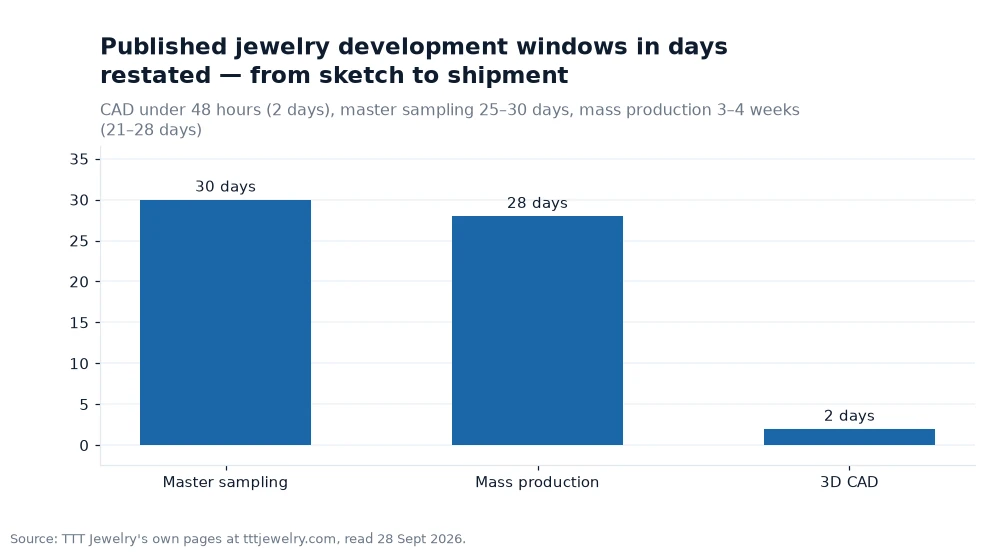
A private-label brass collection is built around three published numbers: a MOQ of 100 pieces per design, a master sampling window of 30 days and a mass production window of 28 days. Add the two-day CAD stage and a first order covers 60 days of factory time, so a launch date is best set backwards from the shipping week.
Key takeaways
- Private-label work starts at 100 pieces per design in artisan eco-brass, the published MOQ for the material.
- The published windows are 2 days of CAD, 30 days of sampling and 28 days of production — 60 days in total.
- Branding is handled by laser engraving, with hallmarks published as 18KGP for gold-plated pieces, the S925 hallmark and 316L on stainless.
- Designs are covered by 100% NDA and stay exclusive, with moulds and CAD files not resold.
What private label changes about a brass order
Nothing about the metal, and everything about the file. A private-label order takes the standard custom brass jewelry production route — casting, sprue cutting, polishing, surface art, plating, coating — and adds a layer of branding decisions on top of it.
The advantage of starting on brass is that the appearance comes from the plating rather than the alloy, which means the same base casting can support a gold or a rhodium finish without changing the tooling. For a first collection with more than one colourway, that is a real saving in development time.
Branding a brass piece: engraving, hallmarks and tags
Logo and hallmark work is published as high-precision laser engraving, with the purity hallmarks S925 for sterling silver, 316L for stainless steel and 18KGP for gold-plated pieces. On a plated brass range the relevant mark is 18KGP, and its placement has to survive polishing and plating.
That makes the marking a drawing decision rather than a finishing decision. A wordmark on a polished face and one inside a band look completely different under a multi-layer gold plate, and a laser pass cannot be undone on a finished piece.
Packaging as part of the label
Private label means the carton carries the brand as much as the piece does. The published packaging components are backing cards, pouches in velvet or microfiber, foil-stamped boxes, metal logo tags and bar-coded labelling.
Each needs artwork and an approval, and the barcode in particular is usually dictated by a retail partner's own numbering. Because packing follows the 100% inspection step, a missing card is the classic reason a finished batch waits in cartons — the metal is done, the label is not.
The 60-day private-label timeline
Read the published windows in days and they line up cleanly: 2 days of CAD, 30 days for the master sample, 28 days for mass production. Together they are 2 + 30 + 28 = 60 days from an approved brief to a shipped batch.
That is the factory's share. Your own approvals sit on top, and so does any artwork that has to be produced for packaging, which is the one item on the critical path that is not bench work at all.
Compliance and exclusivity on a branded line
Two statements cover most of what a stockist will ask. The materials position is REACH compliance on lead, cadmium and nickel, with the plating described as compliant with REACH and California Proposition 65. The quality and labour side is a quality management system documented to ISO 9001:2015 and a BSCI audit.
Exclusivity is published just as plainly: designs stay exclusive to the brand, and moulds and CAD files are not resold. For a private-label collection those are the two sentences that decide whether a design can be built on twice by the same factory for someone else.
Where a private-label launch usually slips
Not in the plating tank. It slips in the two places that belong to the brand: artwork for packaging and the dimensional sign-off on the CAD file. Both are quick to do and easy to defer, and both sit on the critical path.
Suppliers that have run private-label orders before handle this with a dedicated project manager and a 24-hour response window. The point of that structure is not politeness; it is that a question answered in an hour keeps a batch inside its published window.
| Stage | Published window | What the brand supplies |
|---|---|---|
| 3D CAD | 2 days | Sketch, reference photos or a tech pack |
| Master sampling | 30 days | Dimensional sign-off and sample approval |
| Mass production | 28 days | Firm quantity at 100 pieces per design minimum |
| Packing | After 100% inspection | Packaging artwork and barcode numbering |
What the brass line publishes for private-label work
Private label leans on the same published specifics as any other order in the material. The alloy is described as a premium alloy of copper and zinc whose nickel content meets certified standards, the products comply with REACH and California Proposition 65, and the brass is stated as 100% recyclable — the one sustainability line the client writes in its own words.
Finishes go further than karat choice. Advanced gold and rhodium plating layers form a durable barrier described as suitable and comfortable for most skin types, and oxidation or antique finishes are offered where a design wants an aged surface rather than a bright one. A brand briefing a brass jewelry manufacturer China route can treat that page as the specification, because it also publishes a six-step flow: requirement confirmation, CAD design and the precision mould, prototyping finished by hand polishing, electroplating to a high standard with anti-tarnish, sample confirmation, plus a 100% manual inspection before packaging and trackable shipping.
Worked example: dating a launch backwards from shipment
Start with the day the collection has to be in a warehouse. Take off 28 days for production and 30 days for sampling, and the brief has to be settled 58 days earlier. Add the 2-day CAD stage and the total is 60 days, which is 60 ÷ 30 ≈ 2 months.
Now count the buyer-side items that are not in that figure. A dimensional sign-off, a sample approval and a packaging artwork approval each carry their own turnaround. Allow a week for each and the same project needs 60 + 21 = 81 days, or roughly 60 ÷ 7 ≈ 8.6 weeks of calendar at the top end.
Three designs at the 100-piece minimum add 300 pieces of production volume without adding a single day to the windows, because the sampling stage is shared. That is the practical argument for launching a small collection rather than a single style.
Frequently asked questions
What is the minimum order for a private-label brass collection?
100 pieces per design in artisan eco-brass, the published MOQ for the material; 925 sterling silver starts at 50 and stainless steel at 100+.
How long does a first private-label order take?
The published windows add up to 60 days: 2 days of CAD, 30 days of sampling and 28 days of production, before your own approval time.
How is the brand marked on the pieces?
By high-precision laser engraving for logos, with hallmarks published as S925, 316L and 18KGP, plus branded packaging components including tags, boxes, pouches and barcode labels.
Setting up a first branded brass run
Decide the colourway, the hallmark placement and the packaging set in the same pass, then let the factory's own timing drive the calendar. A brand that wants to see where the days go can start with the the factory's process page and the custom jewelry wholesale offering, both of which describe how a first order moves from sketch to shipment.
Where the numbers come from — the eight steps in production and the gold and rhodium plating layers, the REACH and Prop 65 statements — is the supplier's own site through tttjewelry.com, as of 28 Sept 2026. The route comparisons are drawn from those numbers. The percentages quoted above are my own working — the site supplies the inputs only[1].