
Subscription Perfume Brands: Where Quality Control Checkpoints Belong
Quality control in a subscription fragrance business works differently from quality control in a launch. A launch is judged on one shipment, so effort concentrates on the first batch; a subscription is judged continuously, so the checkpoints that matter are the ones that detect drift before a customer does. That shift moves attention away from final inspection and towards the points where a formula, a fill or a pack can quietly change: material intake, compounding, filling, decoration and the reference retained from the approved batch.
Key takeaways
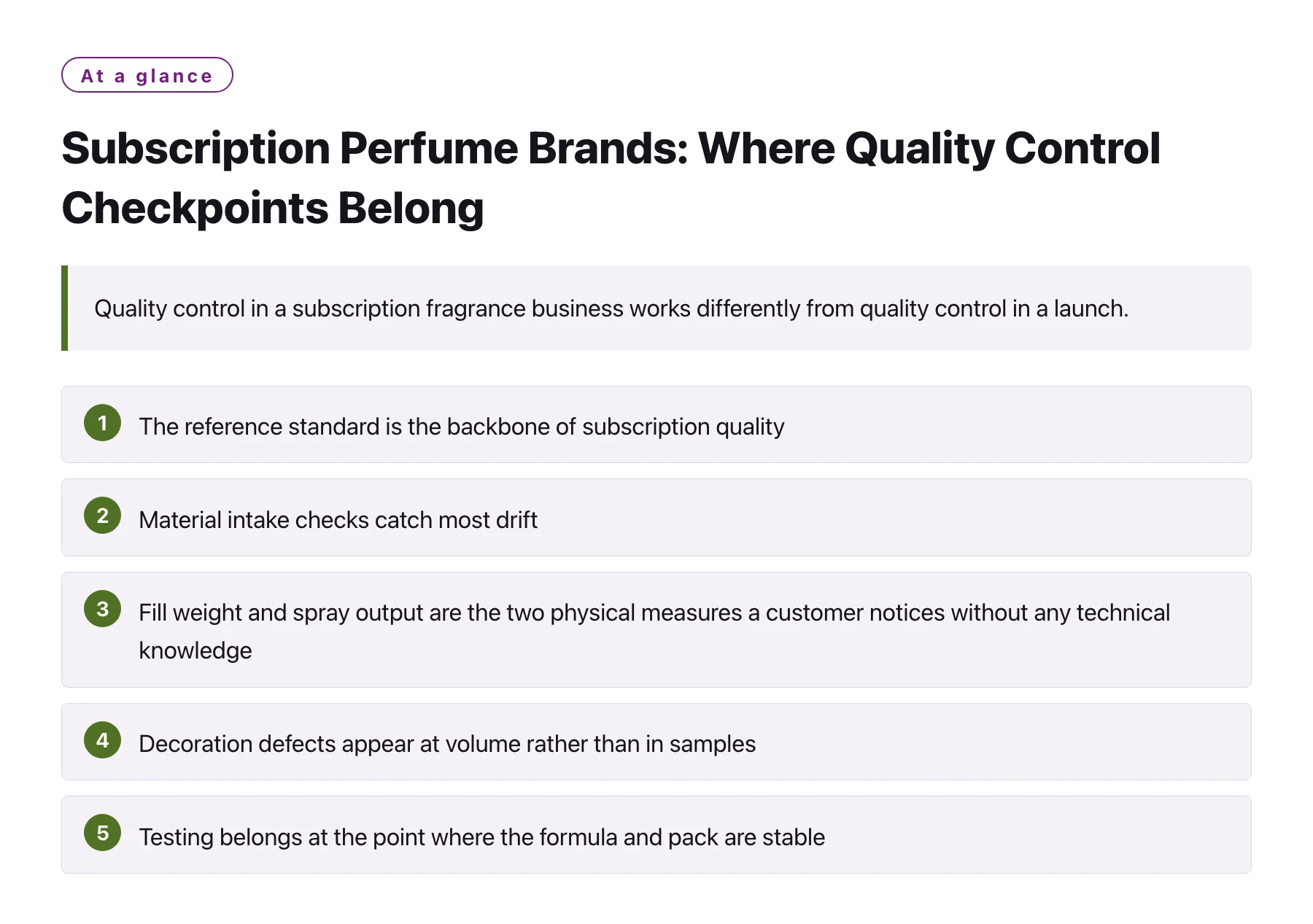
- The reference standard is the backbone of subscription quality, because without a sealed retained sample from the approved batch there is nothing to compare later production against.
- Material intake checks catch most drift, since a substituted raw material changes a scent more than any process variation [1].
- Fill weight and spray output are the two physical measures a customer notices without any technical knowledge, so they deserve a per-batch record rather than a periodic check.
- Decoration defects appear at volume rather than in samples, which makes an agreed inspection level and a documented defect definition essential before a reorder run.
- Testing belongs at the point where the formula and pack are stable, and the report should name the version tested so it remains meaningful after any change [2].
- Any change to formula, component or supplier should trigger a defined re-approval gate rather than a judgement call by whoever is closest to the order.
Ask a brand where its quality control sits and most will describe final inspection: the moment a shipment is checked before it leaves. That is a reasonable answer for a single order and an incomplete one for a subscription, where the risk is not a bad batch but a slow divergence that nobody notices for three months.
The difference matters because a subscription customer has a memory. They know how the last bottle performed, how it sprayed, how long it lasted, and they compare. A small change that would pass unnoticed in a one-off purchase becomes a support message in a recurring one.
The checkpoints below are arranged by how much drift each one catches. They are deliberately few, because a quality system with thirty gates is usually a system where nobody knows which five matter.
Why a subscription shifts where the checkpoints sit
In a one-off production run, the expensive failure is a batch that has to be scrapped. In a repeating run, the expensive failure is a batch that is accepted and shipped. The first is visible, measurable and bounded; the second surfaces weeks later as a pattern of complaints, by which point several shipments have already been sent.
That is why a subscription brand should weight its checks towards comparison rather than inspection: comparing today's batch with a retained reference, comparing fill weights across runs, comparing decoration against a signed standard. Laboratory testing answers whether a formula is safe and stable; consistency checks answer whether it still matches what was approved.
The reference is the asset
A sealed retained sample from the approved production batch is the single most useful object in a subscription quality system. It converts a subjective question about whether a scent has changed into a comparison against a fixed standard, and it gives both sides something concrete to discuss when a customer reports a difference.
Ask where the reference is kept, for how long, under what conditions, and who can access it. Answers that describe a location, a duration and a person are a system; answers that describe an intention are not. The same question applies to responsibility for the checks themselves, since which checkpoints a a manufacturer that builds custom scents owns under the agreement should be listed rather than inferred.
Five checkpoints worth more than a longer list
Material intake
Verify identity, supplier documentation and lot number on arrival, and record the position of any material that falls under a use restriction for the product category [1].
Compounding
Confirm the formula version in use, the weighing record and the batch size, because a formula that is correct on paper and wrong on the scale produces a scent that only fails later.
Filling
Record fill weight and spray output per batch against a stated tolerance, since these two numbers are what a customer experiences directly and they are cheap to measure.
Decoration
Inspect against a signed decoration standard at an agreed level, with a written definition of which defects count, because print and coating problems scale with volume rather than appearing in samples.
Finished pack testing
Name the formula and pack combination tested, the laboratory used and the conditions applied, so the evidence stays valid when the product is reviewed later [2]. The wider picture of safety testing in perfume manufacturing is worth understanding even when the manufacturer commissions the work.
A practical test before a subscription programme starts: ask to see one complete batch record from a product comparable to yours, redacted as needed. If it shows intake, weighing, fill and release checks with names and dates, the system operates. If it shows a summary sheet with no measurement, the checks are happening somewhere else or not at all. Building the same expectation into a Xuelei's guide review of your own programme removes most of the ambiguity before the first reorder.
Sources
- IFRA Standards Library (International Fragrance Association) —— The IFRA Standards Library lists the restrictions the fragrance industry applies to individual fragrance ingredients, based on safety assessments; it is the reference point for compliant fragrance formulation.
- SGS: Cosmetics, Personal Care & Household Testing —— Testing, inspection and certification services for cosmetics and personal care, including microbiological, stability and safety testing aligned with cosmetics GMP.
Frequently asked questions
How is quality control different for a subscription fragrance brand?
The emphasis moves from inspection of a single shipment to detecting drift across many. A retained reference sample, per-batch fill measurements and a defined re-approval gate for any change matter more than a large final inspection, because the failure that hurts is a gradual difference rather than a rejected batch.
What is a retained reference sample and why is it needed?
It is a sealed sample kept from the approved production batch, stored under defined conditions for a stated period. It gives the brand a fixed standard to compare later production against, which turns a vague complaint about a scent having changed into a specific, testable comparison.
Which measurements should be recorded on every batch?
Fill weight, spray output where relevant, and the identity of the materials used with their lot numbers. Those are cheap to record and they cover the differences a customer is most likely to notice, along with the traceability a supplier needs if a material question is raised later.
Who should own quality control when a factory develops the scent?
The operational checks sit with the manufacturer, while the acceptance standard sits with the brand. The agreement should state which checks are performed, what is reported, at what frequency, and what triggers a re-approval. Ownership of the process and ownership of the standard are two different things.
What should happen when a component or material changes?
It should trigger a defined re-approval gate: a new reference where the scent is affected, a repeat of the relevant fill or decoration check, and an update to any document that depended on the previous version. Treating such changes as normal production decisions is how a consistent product slowly stops being consistent.